
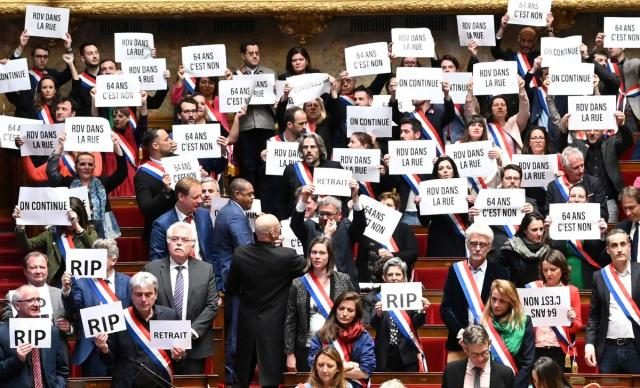
Street protests in France are expected to continue just as Emmanuel Macron’s government survived a no- confidence vote in France’s parliament after pushing through his hugely unpopular pension reform..
The pension reform seeks to raise the minimum retirement age from sixty-two to sixty-four.
With the vote, the prime minister, Elisabeth Borne retains her position, but the president will face a herculean task trying to calm nerves as the street protests show no sign of abating.
Government insiders, opposition politicians and observers have raised fears that France could experience another round of spontaneous, anti-government revolt in cities and small towns – not just over raising the pension age to 64, but also because of distrust in the political system, only a few years after the gilets jaunes movement shook Macron’s first term in office.
Some observers said one option for Macron in the coming weeks could be to replace Borne and reshuffle the government to try to reset his image.
The first no-confidence motion, put forward by Charles de Courson, France’s longest-serving MP and a member of the small opposition centrist grouping Liot, was narrowly defeated – it fell short of the required absolute majority by only nine votes. A total of 278 MPs voted in favour.
The motion won the support of politicians from the leftwing grouping, Nupes, as well as Marine Le Pen’s far right, independents and some MPs from the rightwing Les Républicains.
A second no-confidence motion tabled by Le Pen’s party, National Rally, was rejected. After the government won both votes, Macron’s proposed changes to the pension system are likely to swiftly become law. But France’s constitutional council will be consulted on the law and opposition parties want to petition for a form of referendum.
Under Macron’s changes, the minimum general retirement age will rise from 62 to 64, some public sector workers will lose privileges and there will be an accelerated increase in the number of years of work required to qualify for a full pension.
But tensions are likely to continue on the street in the coming days, with a major day of strike action and protests planned for Thursday. Macron is under pressure to address the nation and clarify how he intends for the government to keep working, and whether there could be a reshuffle. Macron’s centrist grouping lost its absolute majority in elections last June, leaving the government in a weak position.
The no-confidence motions were called in protest at the government using controversial executive powers to push through the pension changes on Thursday without a parliament vote.
Macron had previously decided that the government should use article 49.3 of the constitution to bypass parliament, because he feared he could not garner enough support from lawmakers.
The centrist Courson, presenting the no-confidence motion, told parliament that the government’s move to push through pensions changes without a parliamentary vote was a “denial of democracy”. He said the proposals were unjust and had sparked “tension, worry and anger” in France.
Boris Vallaud of the Socialist party said the government had “perverted democracy” and shown “arrogance and disdain” towards parliament, opposition politicians, trade unions and insulted “the intelligence of citizens on their own future”.
Olivier Marleix of the rightwing Les Républicains party, which the government will probably have to depend upon to pass any future legislation, delivered a blistering speech saying Macron must change his approach to power.
With reports from the Guardian