
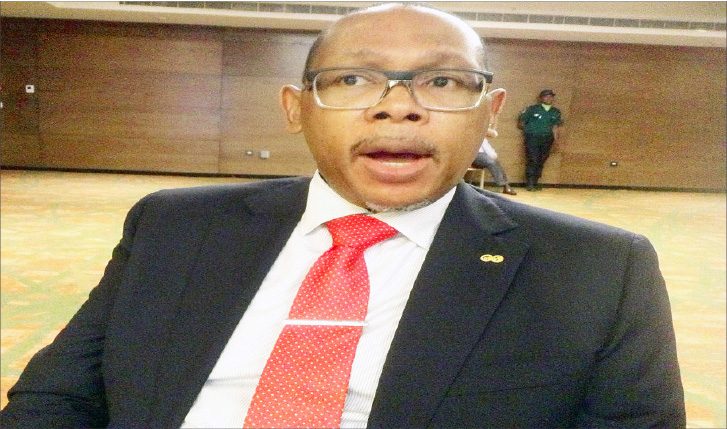
…make case for production sharing gas contract
The Society of Petroleum Engineers, Nigeria (SPE) has concluded plans to host its Nigeria Annual International Conference and Exhibition (NAICE) 2018 conference which has been scheduled to hold from 6 to 8 August, 2018 at Eko Hotel and Suits, Lagos.
The SPE, while making this known in Lagos, frowned at the non-existence of Production Sharing gas Contracts (PSCs) in the country’s oil and gas sector.
Though, Nigeria has an existing Production Sharing Contracts (PSC), which is strictly for oil production, the absence of gas contract, according to the SPE Nigeria Council Chairman, Chikezie Nwosu, is inhibiting gas development in the country.
Nigeria so far lost $21 billion to foreign oil companies operating in the country due to non-implementation of the tenets of the PSCs in the last 20 years.
It was gathered that most of the PSCs in use today in the country, were signed in the ‘80s and 90s’ respectively when crude oil was trading at around $10 a barrel and exploration technology in shallow waters and deep offshore fields were still expensive.
Industry experts therefore argued that previous governments failed to exploit the opportunity of Deep Offshore Act that made provision for premium element to be shared once the price of crude oil exceeds $20 a barrel.
Nwosu, who expressed the association’s support for fair fiscal policies in the country, emphasised the need for the Federal Government to develop Production Sharing Gas contract to enable the International Oil Companies (IOCs) deliver on gas development in the country.
He said that there has not been much development of associated or non-associated gas by IOCs due to the absence of PSC gas contracts.
To achieve low cost of producing a barrel of oil in Nigeria, the SPE Chairman also stressed the need for the country to eliminate whatever that stimulates high cost of production in the country’s oil sector.
He identified long contracting circle as one of the challenges that leads to high cost of producing a barrel of crude oil in Nigeria.
According to him, some contracts have not been approve for over 13 years in Nigeria.
“If we can reduce the contracting circle to three to six months, the cost of delay the approval of contract will be eliminated”, he said.
He also stressed the need for the International Oil Companies (IOCS) to reduce home-country cost, saying this will lead to a lesser cost of production.
Speaking on the Petroleum Industry Fiscal Bill (PIFB), Nwosu said that the PIFB strives to create an equitable distribution of each barrel of oil between government and investors / operators, with recognition of ‘terrain equity’.