
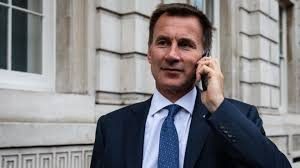
Two technology companies from Nigeria and UK have signed a £56 million agreement to provide card technology that would allow commuters to travel with public transport without cash or a paper ticket.
The UK Foreign Secretary, Mr Jeremy Hunt, said this during the signing of the agreement between Nigeria’s Interswitch and UK’s Becoz in Abuja.
Hunt said the technology will be similar to London’s Oyster card system, a form of electronic ticket used on public transport.
“I am delighted that the UK’s Becoz and Nigeria’s Interswitch are going to be signing a £56 million contract to provide transport payment technology, similar to the Oyster Card of transport in London, and it is a sign of how UK technology can drive growth of some of Nigeria’s most innovative companies.
“We are establishing a major research hub in Lagos this year in order to bring together entrepreneurs and innovators; these are long term initiatives with benefits to both Nigeria and the UK.”
The foreign secretary also said that the UK sought to enhance its partnership with African countries beyond aid and engage more with industries and transform African economies.
He also said that it was important for Britain to re-evaluate its relationship with countries globally with its near exit from the European Union.
“The British Government wants to reset relationship with Africa to move away from the primary motive of our engagement being aid to one where we engage more with industries of the future.
“I want people in African countries to know that the UK is closely identified with the extraordinary transformation that is happening in Africa at the moment,
“Africa is a continent, which would represent a quarter of the world’s population before too long, and we want to be part of the great African success story that is happening.”
Furthermore, he added that the implementation of the project would be done by Nigerian tech entrepreneurs.
Also speaking with newsmen, Mr Akeem Lawal, Divisional Chief Executive Officer, Interswitch, explained that the card technology system would be built on existing technologies built over the years by the company.
“We have taken all of those technology pieces and we have put it on the infrastructure Interswitch has built over the last 17 years.
“We combine the payment technology with those unique technologies that we have done in partnership with a UK company and we create a solution that will work on Danfo buses, blue buses, in ferries and in trains.
“It will be all across the country; we will start our proof of concept with some of our selected partners in Lagos and Abuja and we will extend to the rest of the country when we are done,” he said.
Lawal said project was a long-term “strategic project” which had sorted out major challenges that would hamper its functionality.
According to him, From the beginning we wanted to design a system that does not depend on power, so the system we have built works 100 per cent on solar.
“The second problem that we solved with the system is the cost; what we have built will cost less than $100 and the third is to recognise that because communication is a challenge we need to build a system that can operate very seamlessly offline,” he added.
Central banks in gold rush amidst dollar worries
The world’s demand for gold rose in the first three months of 2019 as central banks diversified away from the dollar amid concern over geopolitical instability, the World Gold Council industry body has said.
Global demand increased by seven percent to 1,053.3 tonnes in the first quarter compared to a year earlier, the WGC said in a quarterly report on the precious metal.
Purchases by central banks hit 145.5 tonnes of gold, up 68 percent. That was the best performance for that period since 2013.
“Central banks are diversifying away from the dollar,” WGC spokesman John Mulligan told AFP.
The report added that “diversification and a desire for safe, liquid assets were again the main drivers of the purchases”.
Gold demand from exchange-traded funds (ETFs) meanwhile jumped 49 percent to 40.3 tonnes. ETFs — which allow investment without trading on the futures market — witnessed the biggest inflows in the United States and also in Europe.
ETF demand for gold was “underpinned by continued geopolitical instability” in Europe, the WGC said.
The main two drivers of gold — which is regarded as a safe haven investment in times of economic turbulence — are investment buying and jewellery.
In the first quarter, jewellery demand rose one percent to 530.3 tonnes on particularly keen demand from India.
Bar and coin investment demand however fell one percent to 257.8 tonnes from a year earlier, hit by profit taking in Japan.