
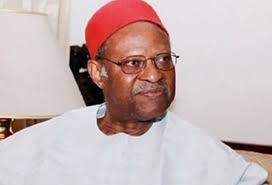
The former Commonwealth Secretary General, Emeka Anyaoku has asked the nation to look more towards India than the United States in search of more practical mechanisms to managing many of the recurring fault lines in Nigeria; particularly with regards to religion, ethnonationality and competing cultural identities.
Anyaoku said, “It has become quite clear that these national challenges cannot be effectively tackled under the present federal system of government.”
“The country (Nigeria) is no doubt in a serious crisis. We cannot sit by and allow the situation to continue.”
The former Common Wealth scribe made this assertion on Saturday, at the 2021 Obafemi Awolowo Lecture, when prominent national voices including Nobel Laureate Wole Soyinka, the Sultan of Sokoto, Sa’ad Abubakar, and public intellectual Odia Ofeimun came together in a virtual lecture to discuss and analyze the current sorry state of affairs in the nation with a view to proffering solutions to it.
Mr Anyaoku, former Secretary-General of the Commonwealth, speaking as guest of honour, focused on the nature and the management of Nigeria’s federalism which he said was in urgent need of evidence of “equity, justice and fairness for all ethnic groups” as well as the guarantee for the economic freedom of citizens.
“It is and should be in the interest of all ethnic groups and sections and component parts of this country to sustain, nourish and progress this our one country,” the top diplomat said, drilling holes in the current constitution which he said made federalism impossible to implement because it was not born out of consensus and is heavily ladened with unitary instincts that can only be corrected by restructuring the governance template at, what he called, an all-inclusive national dialogue. He put the initiative for ‘urgently initiating’ the dialogue on the federal government and the national assembly.
Mr Soyinka, chairman of the event, said, the current constitution still offered some decent room for manoeuvre if elected political leaders, particularly governors, wanted to truly render dutiful stewardship to citizens. Nothing has been more sickening, the writer said, than seeing elected governors shackle themselves in a “centralist mindset” state when indeed they ought to be challenging some of the unitarist over-reach of the federal government. “Take in your hands any form of authority you can, if possible, constitute legal teams to advise you,” Mr Soyinka counselled the governors, many of whom have been recently criticized as acting as handmaidens of a federal government that often overstepped its bounds to subvert the rights of states and subnational governance structures.
Mr Soyinka backed Mr Anyaoku and the guest speaker, Odia Ofeimun, in calling for a restructuring of current governance principles in the country which he said were unquestionably unitarist and undemocratic. “And for those who claim they do not understand the meaning of restructuring,” Mr Soyinka advised them to invent any available language that helped them understand that the current constitution and the management of federalism in the country made no sense in democratic definition.
Sultan Abubakar, the co-guest of honour, traced the current difficulties in the country to the divide and rule tactics of the British colonial administration, and pleaded with political office holders to show more restraint in their utterances.
“Nation building has always been a slow and painstaking process. This is particularly so when these nations are created by colonial fiat,” the sultan argued, saying “By disrupting the slow but sure process of social integration, they generate social tension, which needs to be managed over time to avoid conflicts.”
A former soldier, the traditional ruler reminded those he claimed were calling for war to remember that “nobody had a monopoly of violence” and that the end of war would not benefit any group, saying “the inaction of government has allowed many avoidable losses of lives to happen,” and that “State actors, which have the primary responsibility to protect lives and property, must be alert and prompt in their duties and responsibilities.”
Mr Odia Ofeimun, a poet, essayist, and former president of the Association of Nigerian Authors (ANA), raised dusts in his advocacy for the decentralisation of the country’s constitutional principles, the important need to protect minority rights, the failed obligations for a social compact with citizens, the unchecked rampage of the agricultural economy of farmers by herdsmen in the middle belt and in the South-west region of the country as well as on the imperative of a mass education programme that will equip the next generation of Nigerians.
Mr Ofeimun’s remarks drew an immediate response and a side debate from Lamido Sanusi, the former emir of Kano and former governor of Nigeria’s Central Bank, who argued that the “extraordinary expensive governance” is probably the most important and fundamental problem for Nigeria, “over ethnicity, religion and the concerns about rebuilding a new consensus for governance.”
Mr. Sanusi reasoned that: “I think building a consensus is a process but the process itself has to be guarded. We have had many so-called national conferences and reports have been written. What happened after that? Nothing. Have we thought that the bloated structure of elective offices is the absolute recipe for irresponsibility? 109 senators and 360 rep members. Who is responsible? 36 state legislatures? Why not reduce the number, make it unicameral, improve quality so they know why they were elected beyond “constituency projects”?”
When, in response to Mr Ofeimun’s assertion of the validity of ethnic identity as a ground for the primary expression of a Nigerian identity, Mr Sanusi’s riposte came in a string of questions: “should we not just recognize that we have multiple identities-ethnic, religious, racial, clan, linguistic etc?” adding, “What is the ethnic identity of a man whose mother is half Yoruba and half Fulani and whose father is half Igbo and half Ibibio? who may be married to a Kanuri wife? I think we need to just ask why we are failing to rise above ethnicity and build a national identity.”
To this point, the academic, Akin Fadaunsi, reminded the former emir that “Nigeria is a patrilineal society,” a prompting that whatever portion of culture affect the definition of a Nigerian, he or she is ultimately defined by the father’s lineage.
The occasion also attracted lively side repartees like when Mr Sanusi claimed that it was President Goodluck Jonathan’s administration that suspended the teaching of Nigerian history in the curriculum of the country’s high schools, and suggested that it was the Buhari administration that restored it in 2015. A speedy response came from Charles Ohanwe, in the virtual audience, that “History was already removed from our nation’s educational curriculum well before GEJ [President Jonathan’s] administration. It was in 2007 that history was removed officially.”
The Obafemi Awolowo Lecture has held annually since the demise of the late Obafemi Awolowo, except in 2020 due to the COVID-19 pandemic, according to the Chairperson of the Obafemi Awolowo Foundation, sponsors of the lecture, Tokunbo Dosumu. Ms Dosumu, a former diplomat, in her opening comments said Saturday’s virtual lecture was organised to draw attention to perceived governance deficit and the apparent insufficient concerns about citizens wellbeing by those in authorities.
“The country is no doubt in a serious crisis”, she said adding, “We cannot sit by and allow the situation to continue. History will judge our generation harshly if we fail to engage,” she stated.