
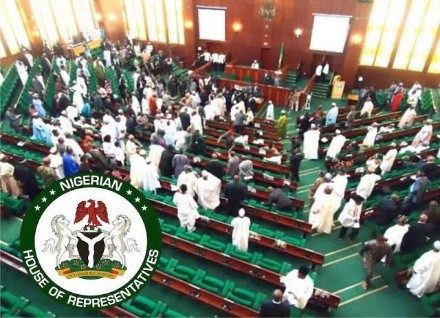
The House of Representatives has unanimously approved and passed for second reading a bill seeking to for an upward review of the minimum academic qualification for the seats of President of Nigeria, governor of a state and other elective public offices to university degrees or their equivalent.
The bill which was sponsored by Adewunmi Onanuga, the lawmaker representing the Ikenne/Sagamu/Remo North Federal Constituency in Ogun State, according to her is intended at attaching premium value to the educational qualification of those aiming for the highest political position in the country and to prepare them for the arduous task of leadership.
The bill titled, ‘A Bill for an Act to alter the Constitution of the Federal Republic of Nigeria, 1999, Cap. C23, Laws of the Federation, 2004, to review the required educational qualification for election into certain political offices and for related matters’, seeks to specifically alter sections 65, 106, 131 and 177 of the 1999 Constitution.
Defending the bill on Tuesday, Onanuga stated: “This is not a bill targeted at stifling the interest of Nigerians in politics; rather, it is a bill that will help Nigerians to sufficiently prepare for the humongous task of political leadership.
“As we have begun to see, the race for elective offices at the state and national levels has become increasingly competitive. While this is good as a tenet of universal suffrage, it can also be counterproductive if people, who are not sufficiently prepared educationally, get into these elective offices.
“All the political offices affected by this amendment are very strategic in their own right. The state legislators are important for making laws to govern the state in the interest of the people. The office of the governor is the highest political office in the state. The federal legislators are important for making laws in the interest of the nation. The office of the President is the highest political office in the land.
“If a managing director, who holds an equally strategic position in a company within this country cannot be employed without a university degree or its equivalent, why should the above political offices be held by people without a university degree or its equivalent?”
“We all know that after a university degree or its equivalent in this country comes the compulsory National Youth Service Corps scheme, without which it will be difficult to get into any employment, especially in the public sector,” she added.
“Invariably, by leaving the qualification for these political offices to remain at the school certificate level, we are implying that the NYSC is not a requirement to hold political offices, but it is a requirement to secure a job in the public sector.
“This bill will reflect the premium this 9th Assembly places on the quality of education that interests our youths vis-à-vis their desired political ambitions; and it will in turn affect the quality of candidates, who run for elective offices in this country.
“Otherwise, how do we place value on education if I say to my son, who wants to be a doctor that he needs a university degree or its equivalent to achieve his dream and then say to my daughter, who wants to be president someday, that she only needs to have a school certificate?”
According to her, the acquisition of a university degree affords an individual certain knowledge, skills and preparedness that could not be attained at the school certificate level. This she reiterated is the practice world over.
She added, “This is not saying that only those with university degrees can lead well; all we will be saying is that we will rather start from there. And I believe we can all agree that a university degree is a good place to benchmark the educational qualification into certain political offices. To agree otherwise will in the long run do our polity and youths a great disservice.”
The Deputy Speaker, Ahmed Wase, who presided over the session after due considerations passed it for the second reading.