
By Our Correspondent
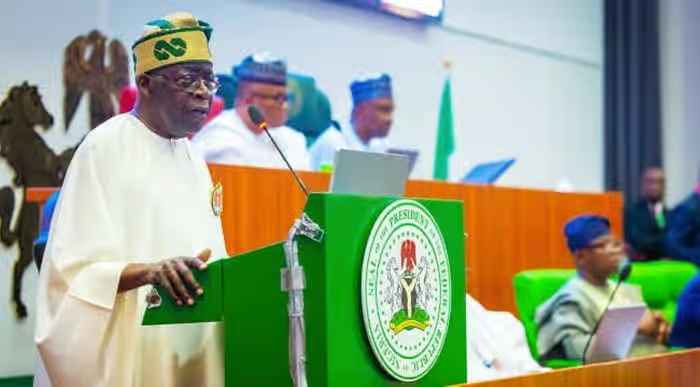
President Bola Tinubu has presented a ₦58.18 trillion 2026 Appropriation Bill to the National Assembly, describing it as a “Budget of Consolidation, Renewed Resilience and Shared Prosperity.” The proposal builds on over two years of economic reforms aimed at stabilising the economy, restoring investor confidence, and translating recovery into better living standards for Nigerians. With projected revenue of ₦34.33 trillion, the budget seeks to balance reform gains with the urgent need for growth, jobs, and security.
Addressing lawmakers at the National Assembly Complex on Friday, the President said the budget prioritises security, infrastructure, and human capital development. In the budget, defence and security are allocated ₦5.41 trillion, while education and health receive ₦3.52 trillion and ₦2.48 trillion, respectively. Capital expenditure stands at ₦26.08 trillion, signalling continued investment in roads, power, agriculture, and other productive sectors. The President stressed that these figures reflect national priorities, not just accounting numbers, and pledged stricter discipline in budget implementation.
Economic indicators cited alongside the proposal point to cautious optimism. GDP growth reached 3.98 per cent in the third quarter of 2025, inflation has moderated steadily to 14.45 per cent, and external reserves have risen to about $47 billion, a seven-year high. Improved oil production, stronger non-oil revenues, and increasing investor interest suggest that recent policy choices are beginning to yield results, offering hope that stability can evolve into shared prosperity.
Analysts have , however, urged caution over rising deficits and debt servicing costs, warning that long-term investor confidence depends on transparency, predictable policies, and efficient use of public funds. Concerns were also raised about underperformance in the 2025 budget execution, highlighting the need for improved revenue mobilization and accountability. Calls have been made to channel more resources into capital projects, strengthen social safety nets, and attract quality foreign direct investment beyond short-term capital inflows.
Despite these challenges, the 2026 budget signals an intention to move Nigeria toward a more peaceful and prosperous future. By tightening fiscal discipline, deepening reforms, and focusing on security, food production, and human development, the government aims to consolidate recent gains. As the President noted, the true measure of success will not be the size of the budget announced, but the impact it delivers in improving lives and building confidence in the nation’s future.