
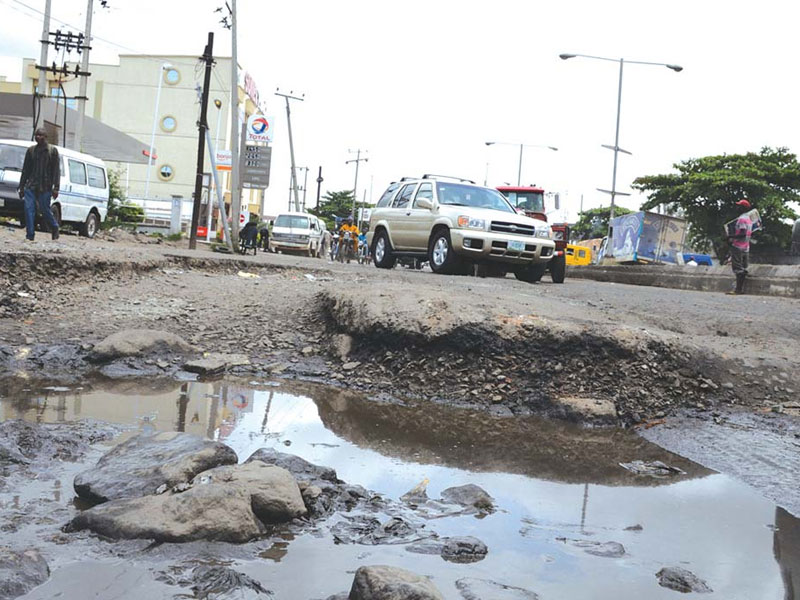
From Lagos to Benin to Bayelsa, Calabar, Owerri, Anambra, Abia ; name it, all across the country, the narrative is the same- the poor state of the roads. All the roads are similar in outlook and are dilapidating in varying degrees. Some are potholes, others have graduated to wide gullies, while in some others the roads have collapsed completely and are impassable, manifesting stark evidence of decades of neglect by successive governments.
Consequently, knowing how vital roads are to any development agenda, this has caused great mayhem on our roads resulting in series of bad effect both on the economy, and more especially on the physical and mental health of the citizens. For instance commuting, during the peak hour in a place like Lagos, say from Ogba in Ikeja to Yaba could take between four to five hours, just going. The Apapa/Oshodi Expressway, The Berger/ Lagos/Ibadan Express way , the Benin/Ore Road etc. This scenario repeats itself on almost every corner of the state and beyond. Precious hours are lost, maintenance cost on vehicles spike and the people go through untold hardship. This drain on the human capital is unquantifiable monetarily. And one cannot compute exactly how much the nation loses economically, operation of businesses, safety of lives and properties, while the government looks on as if nothing is happening. This is a shame.
Statistics have it that there are over 198,000 Km of road network in the country and about 60% of these federal roads are either in total state of disrepair or are non-functional. Lagos alone has over forty five thousand Kilometers of roads. Of these, reports have it that only about nine thousand one hundred Kilometers of road are in fairly good condition.
In Nigeria road traffic accidents are responsible for the majority of deaths, and over half of these accidents are as a result of road defects. The overall road traffic injury rate is about 41 per 1000 population and mortality from road traffic injuries is about 1.6 per 1000 population.
Undoubtedly, insufficient funding has been and still is responsible for the poor state of the roads. A one- time Minister of works and housing, Babatunde Raji Fashola said then that of the over N300bn required by his ministry, only about N30bn was made available. There is no doubt that nothing has changed. The story remains the same.
Knowing the importance of this very basic infrastructure – good roads- to the economy, and how pivotal it is for the facilitation of not just human movement but also of goods and services, one would have expected that provision of this very basic need should have been government top priority.
Given the enormity of the problems at hand, there is, therefore, urgent need for the Federal Government and all state government to make repairs and construction of roads first on their agenda, thus easing up traffic and ensuring the free flow of traffic.
Government can achieve this by simply being innovative. They can figure out new ways of addressing these problems:
First, in the immediacy, as pointed out earlier, government can decide on embarking on patching up every pot hole, and in some undertake some very extensive repair work.
While this is on-going, federal and state government should on the long run, develop a national road policy that will include road designs and standards. Government must ensure that future road contractors work in compliance with the set standards. Government should also make sure that construction companies who bid for road constructions must be well screened and reputable firms with a name to protect.
By so doing, contractors must be subjected to sign agreements that within a fixed period of time, should there be any defect they can always be called upon to correct them. That is maintenance without payment.
An independent committee should be set up to look into the quality of materials used for road construction to ensure that they meet the standards.
Government must begin to look seriously into establishing and developing alternative means of transportation. Such as the water ways, reviving the railway system and upgrading and making it more modern and fit for decent people. This will in effect discourage the use of personal cars thus reducing the number of cars on the road.
Other measures in the interim will include the massive involvement of Federal Road Safety Corps members to control the traffic especially during peak hours and in the area where commuters experience the most gridlock to facilitate free and easy movement.
After all said and done, the most important is sincerity on the part of our leaders. They must know that the real reason they are in government is to serve. They must therefore discharge that duty with honesty and fairness. This indeed will spare the citizens from the perils of bad governance.