
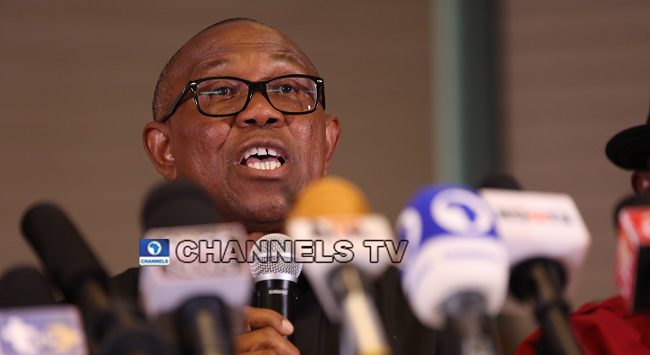
The flag bearer of the Labour Party (LP) in Nigeria’s just-concluded presidential election, Peter Obi says he won the poll and he will explore all legal options to reclaim his mandate.
Addressing a press conference in Abuja on Thursday, for the first time since the presidential election was held Obi assured Nigerians that he would follow every legal and peaceful means to take back his mandate.
“We will explore all legal and peaceful option to reclaim our mandate. We won the election and we will prove it to Nigerians.”
The Labour Party presidential candidate criticized the inability of Nigeria to conduct free and fair elections since independence and vowed to challenge the process.
“I am challenging the process,” Obi said, adding that the process through which a person attains something was very fundamental, if we must build a new and better Nigeria.
“We won the election and we will prove it to Nigerians,” he said.
Obi declined giving any further information on how he intends to go about convincing the court of his victory given that most court cases end up not changing anything. He said evidences will be presented in court, even as he dismissed the notion that the court case will be an effort in futility claiming that in all his political career he has been a beneficiary of the judicial system.
Obi questioned figures showing a low turnout at a time when there was a record number of registered voters. According to him about 11million new voters were added to the previous number of registered voters for this election.
INEC said total votes cast were just under 25 million, out of 87 million people with voter identity cards and eligible to vote, giving a turnout rate of 29%.
“The good and hardworking people of Nigeria have again been robbed by our supposed leaders,” said Obi
Tinubu was declared the winner with 8.79 million votes. Nigeria has a population of more than 200 million.
The opposition parties said the vote had been rigged after new technology that INEC had promised would make the process more transparent instead malfunctioned, eroding trust.
Nigerian elections have often been marked by fraud allegations and violence.
In a bid to address some of those concerns, the Independent National Electoral Commission (INEC) this year had introduced biometric voter identification for the first time at the national level as well as IReV, a central online database for uploading results.
But some voters and opposition parties said failures in the system when uploading tallies allowed for ballot manipulation and disparities in the results from the manual counts at local polling stations.
International observers, including from the European Union, also noted major logistical problems, disenfranchised voters and a lack of transparency by the INEC.
An umbrella group of Nigerian civil society organisations and observers said the process “cannot be considered to have been credible.”
“Given the lack of transparency, particularly in the result collation process, there can be no confidence in the results of these elections,” The Situation Room coalition said on Wednesday.
Glitches with the new technology caused huge delays and queues, discouraging some people from voting.
With a number of registered voters at 93.4 million, the INEC said turnout was just over 27 percent — even less than in the previous 2019 election.
Obi, who for many especially young Nigerians represented hope for change, said the election “will go down as one of the most controversial elections ever conducted in Nigeria.”
With reports from AFP