
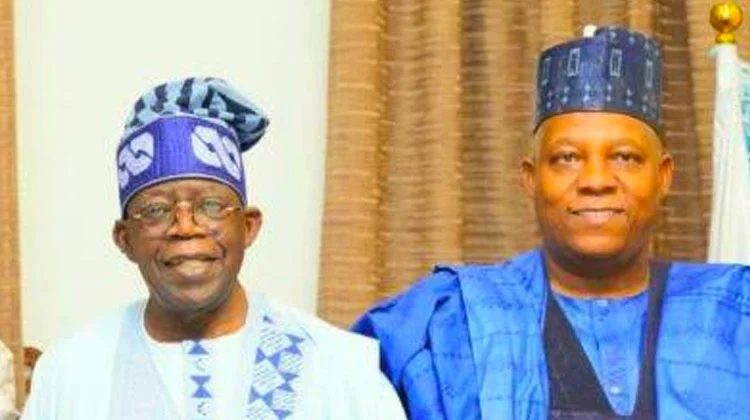
Bola Ahmed Tinubu, the 71year old veteran politician and presidential candidate of the ruling All Progressive Congress was Wednesday presented with the certificate of return as president-elect, having won the just concluded presidential election, which took place on the 25th February.
Tinubu polled 37% of the vote, according to official results by the Independent National Electoral Commission, INEC. His main rivals, Atiku Abubakar of the main opposition the People’s Democratic Party, PDP, and Peter Obi of the Labour Party, LP, polled 27% and 25% respectively to come second and third in the very tightly contested election.
However, these parties alongside majority of the young people who came out against all odds to vote for candidates of their choice, have condemned the poll, dismissing it as a sham and a stolen mandate. They are therefore, demanding for the total cancellation of the results, which they claim was doctored and not a true reflection of the wishes of the people and are also calling on the chairman of INEC, Prof. Mahmood Yakubu to resign his appointment and give room for a new person, more credible and with proven integrity to conduct a fresh election.
A coalition of the aggrieved political parties, have indicated interest in contesting the election results through civil litigation, while some youths have taken their case in protest to the inec’s office.
At a news conference later, Mr Obi’s running-mate Yusuf Datti Baba-Ahmed urged his supporters to stay calm.
Labour’s lawyers were “putting the papers together” to challenge Mr Tinubu’s victory in court, he added.
Mr. Tinubu, in a conciliatory tone, during his acceptance of the certificate of return at Eagles Square in Abuja, called on the opposition parties to shield their swords and accept the results.
In his speech, Tinubu recognized the long journey that brought him to where he is today and appealed to the opposition to join hands with him in building a better Nigeria.
“I take this opportunity to appeal to my fellow contestants to let us team up together. It is the only nation we have. It is one country and we must build it together,” he said in a televised speech.
He added that they had the right to challenge the results in court but said that the lapses in the election “were relatively few in number and were immaterial to affect the outcome of this election”.
According to official results, voter turnout was 27%, one of the lowest since the end of military rule in 1999.
With about 8.8 million votes cast for Mr Tinubu, he was the choice of less than 10% of the record 93 million Nigerians who registered to vote, helped by a divided opposition.
A newly introduced electronic voting system seems to have eliminated the ballot-stuffing that happened in the past and helped present a more accurate picture of the voting population.
But given that 87 million people actually collected their voter cards before election day – which was not an easy process and involved queuing for hours – it is more likely that problems on voting day, rather than voter apathy, was responsible for the low number of ballots cast.
Many potential voters left polling stations without casting their ballots after voting did not start on time in many places.
In some opposition strongholds, voting did not take place at all and there were also cases of ballot-box snatching and voter intimidation in southern states such as Rivers, Lagos and Delta.
Mr Tinubu is one of Nigeria’s richest politicians, and based his campaign on his record of rebuilding the biggest city, Lagos, when he was governor.
He was nevertheless defeated in the city by Mr Obi, a relative newcomer who mobilised the support of many young people, especially in urban areas, shaking up the country’s two-party system.
Mr Tinubu won most other states in his home region of the south-west, where he is known as a “political godfather” – for helping to put others into office.
He campaigned for the presidency under the slogan: “Emi lo kan”, which means “It’s my turn” in Yoruba.