
US planemaker Boeing has agreed deals worth an overall $9.3 billion to sell 50 jets to Nigeria’s Green Air and 30 to Saudi carrier flyadeal.
The company lauded the Nigeria accord, which includes a further 50 options, as the largest signed to date in Africa.
As with the Saudi deal, the Nigerians are purchasing single-aisle 737 MAX planes.
“While flyadeal has been operating new Airbus A320s, the airline says it has selected the 737 MAX for the future,” Boeing said in a statement.
The firm noted its first deliveries to Saudi Arabia were in 1945, as those DC-3 aircraft “gave birth to commercial air travel in the kingdom”.
Flyeadeal is a subsidiary of Saudi Arabian Airlines and flies to a range of domestic destinations across the kingdom.
Boeing quoted the director general of Saudi Arabian Airlines, Saleh bin Nasser Al-Jasser, as saying: “The demand for air transport services in the domestic market of the Kingdom of Saudi Arabia has grown exponentially,” adding flyadeal had ambitions eventually to “cover new markets outside of Saudi Arabia”.
The flyadeal is for the 189-seater 737 MAX 8, whose operating costs Boeing said were eight percent lower than the carrier’s current fleet of Airbus A320s.
If all the purchase options are exercised, the two deals unveiled Friday will be worth around $17.6 billion at list prices.
Green Airways owner Babawande Afolabi said the Nigerian end of the deal was a strong sign of growing African entrepreneurial dynamism and resilience.
Boeing saw that deal as a step towards construction of a “solid” Pan-African network, adding the Africa aviation sector has “exceptional” potential.
Since launching the 737 MAX Boeing said it has received more than 4,800 orders from more than 100 customers worldwide.
European rival Airbus said earlier this month it had 380 net orders for planes from January to November with 673 deliveries over that period.
Boeing said it had landed 631 orders between January and September.
Meanwhile, the Nigerian Airspace Management Agency (NAMA) has commenced the upgrade of its Instrument Landing System (ILS) at the Nnamdi Azikiwe International Airport, Abuja to Category three (CAT3).
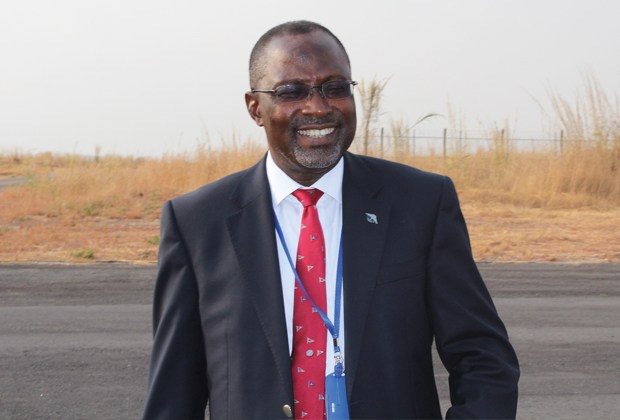
NAMA Managing Director, Mr. Fola Akinkuotu, said in Abuja said the move was to support the newly inaugurated international terminal.
He said the CAT3 ILS would improve the capability to land airplanes in very poor visibility, adding that the new terminal had avenue for expansion.
The managing director said that increased traffic means more airplanes would come in ”and so we have to provide more manpower in terms of air traffic controllers”.
“We are planning to improve and actually, we are close to achieving a higher level landing navigational aid in Abuja in anticipation of the new international terminal.
“Except for some bureaucratic bottleneck, we should have had a Category 3 landing system here which will improve our capability to land airplanes in very poor visibility, rather than we have right now.
“To a good extent, we have foreseen the possibilities that we are seeing today and we will be able to match whatever are the demands.
“Approval has been given, contracts have been awarded and construction has started for the installation of the Category 3 landing system and I think before the end of January, it will be ready.
“We are planning this category of ILS on Lagos and Abuja airports for a start and the next point of call will be Kano,’’ he said.
Akinkuotu said that all the stakeholders in the airport had been sensitised and were prepared to improve their capabilities to meet up with the demands of the CAT3 ILS.
He explained that the Federal Airports Authority of Nigeria (FAAN) would have to ensure uninterrupted power supply within the airport while airlines had to equip their aircraft and train their pilots.
According to him, the pilots would have to be properly trained for low visibility approaches and approach light would have to meet category 3.
He said that mobile control tower had been deployed to enable air traffic controller to be able to have visible access to both ends of the runway pending when new control tower was built.
He explained that the concept and design of the terminal building had some flaws which made it difficult for the control tower to have a complete aerial view of the two end of runway.
“This will be fixed in medium term because with the adjustment of the master plan, we will achieve that. However, since it is a necessity, we provided a mobile tower.
“NAMA will continue to improve on the services that it provides and we want to achieve our category 3 ILS in major airports in 2019 and improve our aeronautical information system,’’ he said.
It would be recalled that President Muhammadu Buhari last Thursday inaugurated the 15 million passenger capacity terminal constructed by the China Civil Engineering Construction Corporation.
The terminal at Abuja airport is one of the four new ones being constructed at the cost of $600 million under the $500 million loan from China-Exim Bank and $100 million counterpart funding from the Federal Government.
The others are in Lagos, Port Harcourt and Kano.
The Port Harcourt terminal was inaugurated by Buhari in October while the remaining two are expected to be ready for use in 2019.