
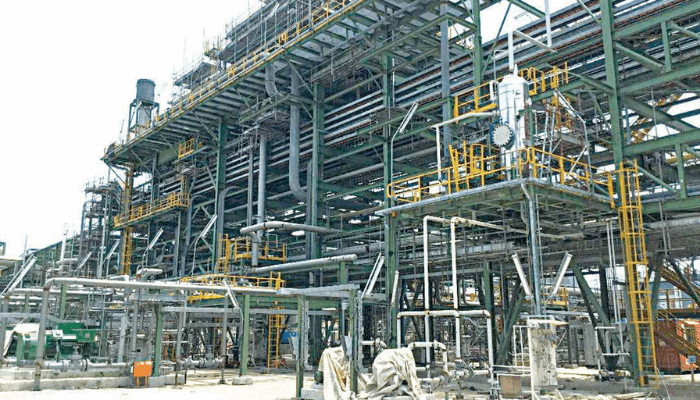
President Muhammadu Buhari will today, commission the Dangote refinery, a 650,000 barrels per day (bpd) facility expected to be the biggest single refinery in the world.
The refinery is expected to add about $21 billion (N9.7 trillion) yearly to the Nigerian economy according to the Nigerian Economic Summit.
Among those expected to grace historic event are Presidents of Togo, Gnassingbé Eyadéma; Ghana’s Nana Akufo-Addo; President of Senegal, Macky Sall; President of Niger Republic, Mohamed Bazoum, President of Chad, Mahamat Déby and a host of ambassadors as well as other international dignitaries.
President Paul Kagame of Rwanda, who will not be physically present will however present his goodwill message virtually.
Nigeria’s President-Elect, Bola Ahmed Tinubu is also expected to be present.
This event is an epoch making one given that this is the first time a refinery of such magnitude built by an individual will be commissioned, with most either moribund or dysfunctional.
Prior to now, virtually all refineries built in Nigeria had been solely owned by the Federal Government. The commissioning of Dangote Petroleum Refinery is significant given that it is the first time that a refinery of such magnitude built by an individual is being commissioned.
The question on most lips is ; what happens to the federal and state owned refineries in Port Harcourt, Warri, Lagos and Kaduna, now that Dangote refinery has come on stream?
Dangote’s petroleum refinery is expected to meet the needs of Nigerian consumers and those in neighbouring countries, while allowing for exports beyond the African continent. The refinery will drive the promotion of the African Continental Free Trade Area (AfCFTA) as over 50 countries in the trade bloc depend on imported refined petroleum products.
According to the Facts Sheet on Dangote Petroleum Refinery, the new Refinery can meet 100% of the Nigerian requirement of all refined products (Gasoline, 53 million litres per day; Diesel, 34 million litres per day; Kerosene, 10 million litres per day, and Aviation Jet, 2 million litres per day) and also have surplus of each of these products for export.
“The refinery is designed for 100% Nigerian Crude with flexibility to process other crudes. It has a self-sufficient marine facility with ability for freight optimisation and the largest single order of 5 SPMs anywhere in the world. Diesel and Gasoline Products from the refinery will conform to Euro V specifications.
“The refinery design complies with World Bank, US EPA, European emission norms and Department of Petroleum Resources (DPR) emission/effluent norms. State-of-the-art technology. Designed to process large variety of crudes including many of the African Crudes, some of the Middle Eastern Crudes and the US Light Tight Oil,” the Facts sheet added.
It also stated: “65 Million Cubic Metres of sand dredged costing approximately Euros 300 million, using the world’s largest, the second largest and the tenth largest dredgers to elevate the height by 1.5 metres, to insure against any potential impact of increase in mean sea level due to global warming. Bought over 1,209 units of various equipment to enhance the local capacity for site works.
“332 cranes to build up equipment installation capacity. Built the world’s largest granite quarry to supply coarse aggregate, stone column material, stone base, stone dust & material for the breakwater. (10 million tonnes per year production capacity).
“Developed a port and constructed two quays with a load-bearing capacity of 25 tonnes/ sq metres to bring Over Dimensional Cargoes close to the site directly. The company also constructed two more quays in the port with a capacity to handle up to Panamax vessels to export fertiliser and petrochemicals and two quays to handle liquid cargoes. The port will thus have 6 quays, including a Roll-on/Roll-off quay”.