
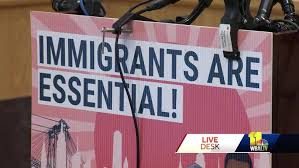
As President Donald Trump moves forward with his pledge to enforce stricter immigration policies, economists are sounding alarms about the potential economic fallout, particularly in industries heavily reliant on undocumented workers. Sectors such as agriculture, construction, and hospitality, which depend on this workforce, could face significant disruptions, worsening the already tight labor market.
Experts argue that the swift and extensive implementation of mass deportations could lead to severe labor shortages, as businesses struggle to adjust. The agricultural industry, which employs a large portion of undocumented workers—up to 30% of crop farmworkers in California—could see serious consequences. Manuel Cunha, president of the Nisei Farmers League, warns that the policy could disrupt food supply chains, particularly in the Golden State, where a significant number of these workers are located.
The construction industry, with around 14% of its workforce undocumented, is also expected to suffer. Jim Tobin, president and CEO of the National Association of Home Builders, predicts a chilling effect on construction activities due to reduced labor availability and rising labor costs.
The hospitality sector is not immune, with leaders like Ada Briceño, co-president of the Unite Here Local 11 union, highlighting the difficulty of filling essential roles. Without a sufficient workforce, maintaining productivity and service standards in the industry could become increasingly challenging.
While the exact scale of labor force reduction remains unclear, economists are concerned that the removal of millions of undocumented workers, along with the possible termination of visa programs such as Temporary Protected Status, could worsen labor shortages. Financial estimates from the Peterson Institute for International Economics predict that deportations could lead to price increases ranging from 1.5% to 9.1% by 2028, while the American Immigration Council projects a loss of nearly $45 billion in federal tax revenue.
Beyond economic ramifications, the policy raises significant concerns for the undocumented workers themselves, who face growing uncertainty about their legal status. Alejandro Flores-Muñoz, a DACA recipient who recently launched a food truck business, says he was driven to take action out of fear that the crackdown could threaten his ability to work and support his family.
This week, the U.S. deported 88 Brazilian nationals, an action that has sparked outrage due to its swift and contentious nature. The broader implications of such deportations on the economy and workers’ lives continue to raise serious questions about the future of immigration policy in the country.