
Mary Onyia
Following the advent of the rainy season and its attendant devastating effect on people and homes, the federal government has set up a new committee headed by Vice President Kashim Shettima to address the broader disaster management issues arising from flooding, erosion and desertification.
Prof. Joseph Utsev, the Minister of Water Resources and Sanitation, disclosed this at a news conference on Thursday in Abuja, while warning people to take precautionary measures to avert possible disasters that accompany the season.
Utsev said that the committee had submitted its report which had been approved by the National Economic Council, with implementation strategies set to commence shortly.
He said the federal government has informed states to be on the alert following recent reports highlighted in the 2024 Annual Flood Outlook by the Nigeria Hydrological Services Agency (NIHSA), adding that state governors are being provided with detailed forcasts and preventative measures specific to their region.
He revealed that the most severe flooding is expected between July and September 2024 with heightened flood risks identified in 148 local government areas across 31 states, including Adamawa, Akwa-Ibom and Anambra.
Mr Clement Nze, Director General of NIHSA, highlighted the Federal Government’s advisory role, noting that enforcement and local action fell under states’ jurisdiction.
He said that the Federal Government would continue its efforts to construct buffer dams, alongside the Lagdo Dam in Cameroon, to mitigate flood risks.
NIHSA’s 2024 Annual Flood Outlook reveals that 148 local government areas (LGAs) across 31 states are at high risk of flooding.
The affected states include Adamawa, Akwa-Ibom, Anambra, Bauchi, Bayelsa, Benue, Borno, Cross River, Delta, Ebonyi, Edo, Imo, Jigawa, Kaduna, Kano, Katsina and Kebbi.
Others are Kogi, Kwara, Lagos, Nasarawa, Niger, Ogun, Ondo, Osun, Oyo, Plateau, Rivers, Sokoto, Taraba and Yobe.
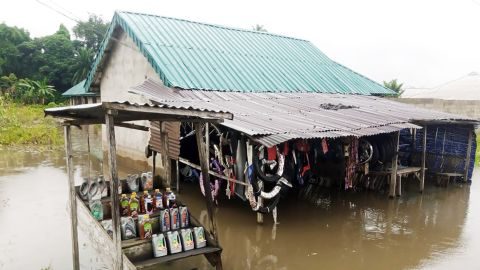
Recall that on Tuesday and Wednesday, some Lagos and Ogun states as well as some parts of the south west experienced torrential rainfall that lasted for hours, leaving in its trail a wide range of devastating effect; flooded roads and homes.
Most people had to use canoes and boats to commute to their offices and homes. Houses were submerged in the flood damaging property and leaving dozens homeless.
Most affected areas around the Lagos metropolis were Ajao Estate, some parts of Ikeja, Iyan Ipaja, Gbagada, Agege and a few others.
With NAN Report