

Key Takeaways
- Venezuela holds the world’s largest proven oil reserves, accounting for about 17% of the global total.
- Despite its vast reserves, Venezuela’s oil production remains a fraction of its historical peak.
Venezuela sits atop the largest oil reserves on the planet, yet its role in global energy markets is far smaller than in past decades.
While countries like the United States and Saudi Arabia dominate daily oil production, Venezuela’s output has steadily declined over the past several decades.
This visualization compares proven oil reserves across major producing countries. Reserves represent the volume of oil that can be economically produced under current conditions. The data for this visualization comes from OPEC’s Annual Statistical Bulletin 2025.
Venezuela’s Unmatched Reserve Base
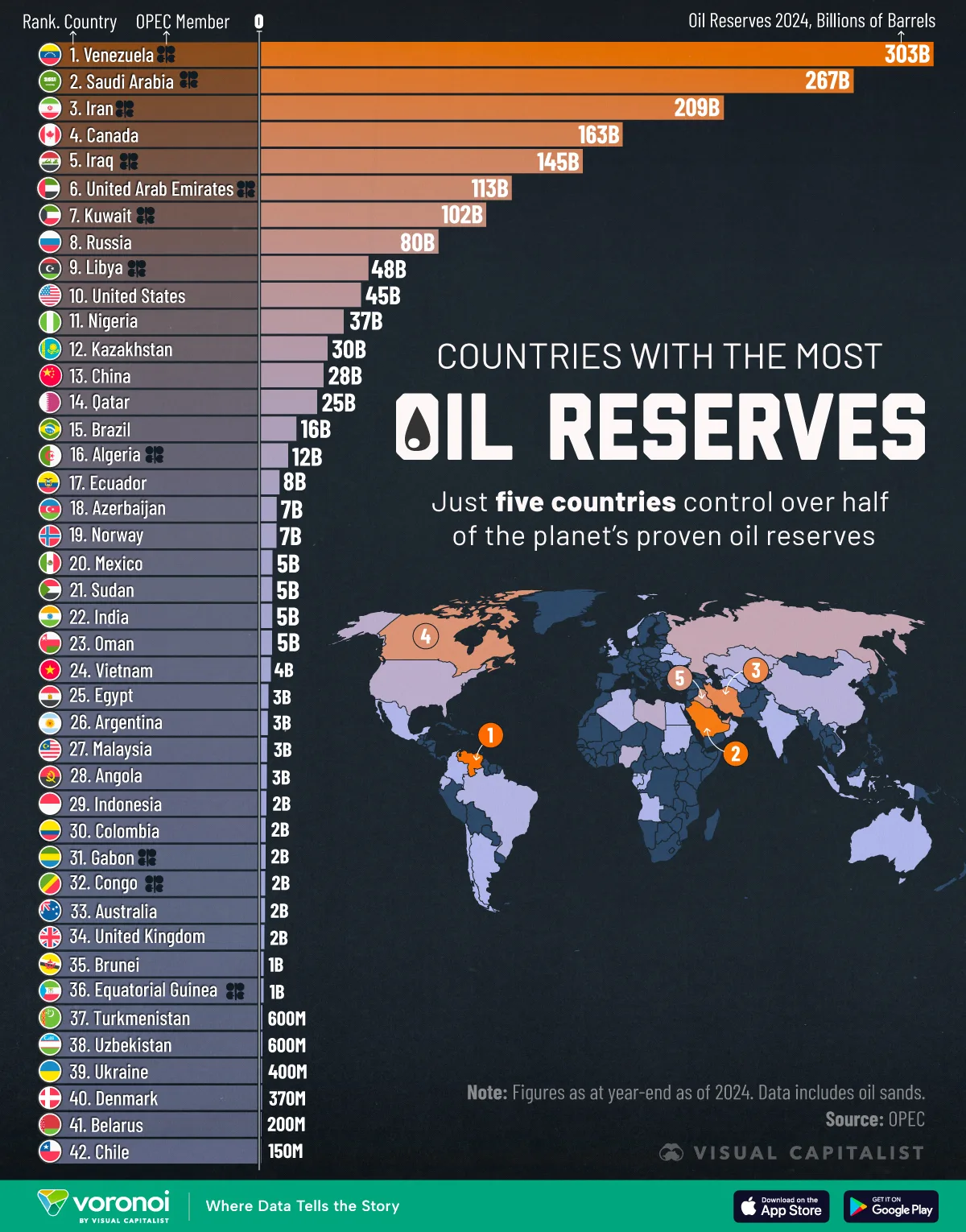
Venezuela holds an estimated 303 billion barrels of proven oil reserves, the largest of any country and well ahead of Saudi Arabia. These reserves account for roughly 17% of the global total.
Most of this oil is concentrated in the Orinoco Belt, where deposits are predominantly heavy crude. While abundant, this type of oil is more expensive to produce and requires specialized infrastructure.
Despite its reserve dominance, Venezuela ranked just 21st in oil production in 2024, producing about 960,000 barrels per day.
At its peak in the 1970s, the country pumped as much as 3.5 million barrels per day, representing more than 7% of global output at the time. Production fell sharply during the 2010s and averaged roughly 1.1 million barrels per day last year, or about 1% of global production.
Politics, Sanctions, and Investment Challenges
Decades of mismanagement, underinvestment, and international sanctions have constrained Venezuela’s oil sector.
Although some Western firms, including U.S.-based Chevron, continue to operate in the country, their presence has diminished significantly as sanctions expanded and exports were targeted.
Venezuela was a founding member of OPEC, alongside Iran, Iraq, Kuwait, and Saudi Arabia, but its influence within the group has waned as production declined.
Key Takeaways
- Venezuela holds the world’s largest proven oil reserves, giving it the highest reserves-to-production ratio by far.
- The U.S. produces oil at almost twice the rate of major competitors Russia and Saudi Arabia, thanks to its booming shale industry.
The recent U.S. operation to capture Venezuelan President Nicolás Maduro reignited discussions this weekend about the Latin American country’s oil industry.
Venezuela currently holds the world’s largest oil reserves – about 303 billion barrels—but its oil industry has struggled in recent years due to mismanagement and U.S. sanctions.
Following Maduro’s capture U.S. President Donald Trump stated that Venezuela’s oil industry would be revived through the entry of American companies into the country.
This chart compares proven oil reserves and daily production across the world’s top oil producers, revealing stark contrasts between output-heavy producers and those sitting on vast untapped resources.
The data for this visualization comes from the Energy Institute reflects oil production levels in 2024.
Ranked: Top Oil Producers and Their Reserves
The United States tops global oil production, pumping more than 20 million barrels per day.
While America’s proven reserves seem low at first sight at just 45 billion barrels, this is due to U.S. shale producers’ short investment cycles which book only a few years of economically viable reserves at a time, and replace them through ongoing drilling.
Countries like Mexico, Argentina, and the United Kingdom also have relatively modest reserves paired with sustained output, though each situation is unique.
Reserve-Rich, Output-Light Producers
Venezuela stands apart from every other producer. With more than 300 billion barrels in proven reserves, its reserves-to-production ratio exceeds 800 years—the highest in the world by a wide margin. Iran, Libya, Kuwait, and Iraq also post triple-digit reserve lifespans.
Countries like Saudi Arabia, Canada, and the United Arab Emirates strike a middle ground. Saudi Arabia’s reserves could last more than 60 years at current output, while Canada’s oil sands give it one of the longest reserve lifespans among high-production countries.

Ranked: The Countries With the Most Oil Reserves
See visuals like this from many other data creators on our Voronoi app Download it for free on iOS or Android and discover incredible data-driven charts from a variety of trusted sources.
Key Takeaways
- Just four countries control more than half of the world’s proven oil reserves.
- Despite the energy transition, fossil fuels still account for nearly 70% of global energy demand
Oil remains one of the most strategically important resources in the global economy. It powers transportation systems, underpins industrial activity, and continues to shape geopolitics and trade flows. While renewable energy is growing, oil still plays a dominant role in meeting global energy needs.
This visualization ranks countries by the size of their proven oil reserves at the end of 2024. The data for this graphic comes from OPEC’S annual Statistical Bulletin 2025 Figures represent proven oil reserves as of year-end 2024 and are measured in billions of barrels. The data includes conventional crude oil as well as oil sands.
Four Countries Dominate Global Oil Reserves
Global oil reserves are highly concentrated.
The Role of OPEC and the Middle East
Many of the world’s largest oil reserves are held by OPEC members, particularly in the Middle East. Saudi Arabia, Iran, Iraq, Kuwait, and the United Arab Emirates anchor the region’s dominance.
These countries benefit from low extraction costs and large, easily accessible reserves. As a result, Middle Eastern producers are expected to remain critical suppliers even as global demand growth slows.
Oil Sands and Non-OPEC Producers
Canada stands out among non-OPEC countries, ranking fourth globally with 163 billion barrels of reserves. The majority of Canada’s reserves come from oil sands, which are more expensive and carbon-intensive to extract. Russia and the United States also rank among the top 10.
Taken together, the data highlights how unevenly oil resources are distributed and why oil-rich nations continue to have significant economic and geopolitical power.
Culled from Visual Capitalist. Com