
By Our Reporter
The Nigerian Economic Summit Group (NESG) has called for urgent sectoral reforms as Nigeria faces a tough road ahead.
The Chairman of the group, Niyi Yusuf, who spoke in Lagos recently, pointed out that inflation, high interest rates, and sluggish sector growth continue to challenge economic stability and might linger this year if not adequately tackled.
Yusuf offered an assessment of Nigeria’s 2025 economic outlook during his speech at the Lagos Business School (LBS), where he emphasized the urgent need for reforms to stabilize the economy and foster sustainable growth.
He highlighted the disparity in sectoral performance and revealed that only four sectors — oil and gas, ICT, finance, and water resources — grew by more than five per cent in 2024.
He, however, noted that these sectors contributed little to job creation.
“The sectors that should create jobs, like agriculture and construction, are underperforming”, he stated.
He stressed that with over 92 per cent of Nigerians working in the informal sector, there is the need for policies that prioritize decent job opportunities, in line with Sustainable Development Goal 8.
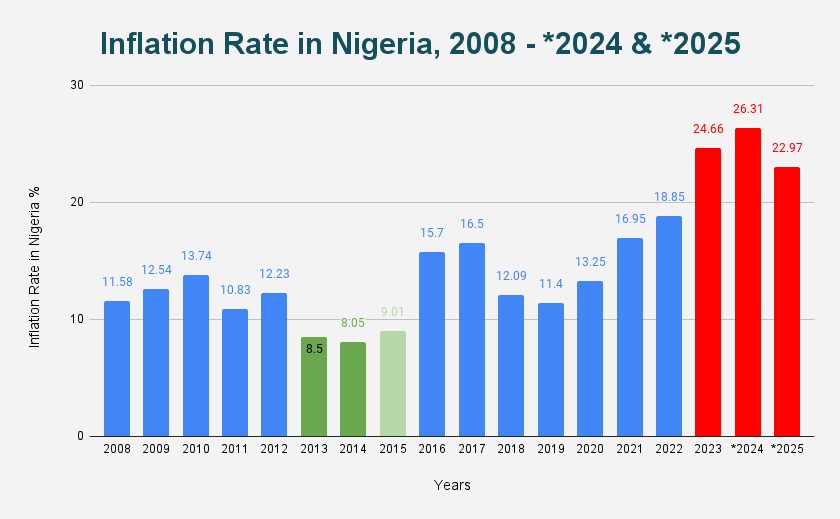
According to Yusuf, inflation remains a pressing concern, with rates peaking at 34 per cent in mid-2024 and projected to stay above 20 per cent through 2025.
He explained that food inflation, a critical driver, stems from insecurity that has displaced farmers across the North and from post-harvest losses, which account for nearly 50 per cent of perishables.
“Without addressing insecurity and improving agricultural productivity, food prices will remain a significant burden”, Yusuf warned.
He also highlighted the challenges posed by Nigeria’s foreign exchange crisis, where crude oil and gas account for 96 per cent of earnings.
While efforts by the Central Bank of Nigeria (CBN) have narrowed the gap between official and parallel market FX rates, the economy remains heavily reliant on oil revenues.
The NESG chairman called for diversification, noting that an import-dependent economy with high inflation and a volatile exchange rate “makes the poor poorer”.
He noted that monetary policy, aimed at curbing inflation, has inadvertently strained businesses. With interest rates at record highs, borrowing has become prohibitive, leading to rising non-performing loans.
“It is difficult for businesses to take loans at 10 per cent to 13 per cent interest and remain profitable”, Yusuf remarked.
He added that high energy and security costs — accounting for 55 per cent of operating expenses for many businesses — further compound the problem.
On infrastructure, Yusuf pointed out inefficiencies in energy and transportation.
“We need investment in infrastructure, including digital and energy systems, to reduce costs for businesses”, he said.
The NESG boss decried the excessive checkpoints along trade routes, such as the sixty-two between Agbara and Seme, which hinder export growth and inflate costs.
Looking to 2025, Yusuf offered a roadmap for recovery.
He urged the government to focus on policy stability, institutional reforms, and investment in security and infrastructure.
“We must stabilize the energy base, address insecurity, and streamline governance by reducing the number of MDAs”, he said, referring to the over 890 ministries, departments, and agencies that burden public resources.
For businesses, Yusuf recommended strategies to build resilience, including local sourcing, cost optimization, and alignment with changing consumer behaviors.
He also stressed the importance of embracing technology and artificial intelligence to unlock new opportunities.