
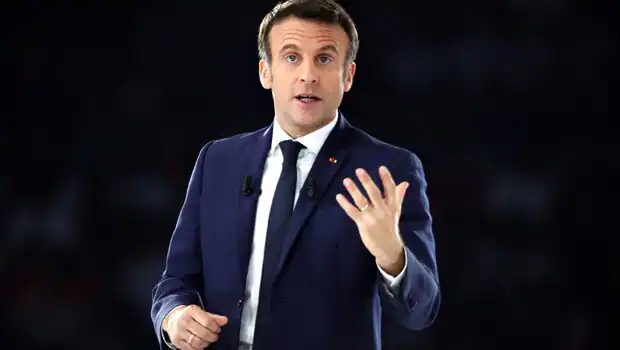
French President Emmanuel Macron has won a reelection on Sunday for another five year term, defeating his ultra- rightist rival Marine Le Pen by 16 percent difference in the run-off vote to clinch the coveted position.
.
The 44-year-old liberal president garnered 58 percent of the votes but saw about half the advantage he’d enjoyed over Le Pen in the 2017 election vanish, a situation that revealed the open wounds in a country after a period marked by several serious crises ranging from the so-called “gilets jaunes” (yellow vest) protests through the coronavirus pandemic to Russia’s invasion of Ukraine.
Another unsettling result of the balloting was the low voter turnout, with absenteeism reaching about 28 percent, the highest in half a century for a presidential runoff, surpassed only during the 1969 second-round vote following the resignation of President Charles De Gaulle after the student riots the previous year and amid a clear call for absenteeism from the French left.
Aware of those problems, Macron was modest in his victory speech delivered with the Eiffel Tower in the background, accompanied by his wife Brigitte and surrounded by a group of children and the strains of the “Ode to Joy,” the European Union’s anthem and the same piece that he praised five years ago at the Louvre Museum after winning the presidency for the first time.
Macron scaled back the victory ceremony from what it had been in 2017 and acknowledged that Sunday’s election result highlighted “a country full of doubts,” promising to work to provide answers for them.
After saying that he had “stopped being the candidate of a party to become the president of all,” he promised to “listen to the silence” of those who refused to cast ballots in the runoff and to “the rage” of those who opted to vote for Le Pen, adding that he would launch “a new era” with a “new ambition.”
The president, who as a result of the constitutional reform of 2008 is limited to serving two consecutive presidential terms and thus will be unable to run again in 2027, acknowledged that launching this new era will not be an easy task.
Macron is the first French president to be reelected since 2002 and the first to win reelection in a runoff during which he also had a parliamentary majority.
He won overwhelmingly in the country’s big cities, among electors with a good amount of purchasing power and among older voters, but he remained unable to convince voters in France’s most depressed areas to back him.
That was where Le Pen did her fishing for votes, having seen how her strategy of cleaning up the image of her Rassemblement National (National Rally) party, focusing her campaign more on those with purchasing power and on the classes of society left behind by globalization, and this enabled her to move up in the polls and, for the first time in history, to exceed 13 million votes.
At age 53 and having run for president three times now, the ultrarightist leader, who had said that she will not run a fourth time, was less categorical on election night about that and told her supporters that she will remain at the front of her party at least until the June legislative elections, which are widely considered to be the “third round” of the presidential vote, since they will determine what parliamentary configuration Macron will have to work with.
Le Pen, although she acknowledged her defeat, complained of “unfair methods” she claimed were used to keep her from winning the presidency, adding that her history-making result “is a victory in itself” and saying that her ideas “have dominated” the campaign and the vote and calling on French voters to strongly support her and her preferred candidates in the National Assembly to “build a counterweight to Macron.”
“In this defeat, I see a kind of hope,” she said, adding that “This result represents for our leaders and for European leaders a challenge that they cannot ignore.”
She warned of the risk that the president has “all the strings of power” in his hands, something that traditionally all previous presidents have only achieved in the legislative elections following the presidential vote.
Macron himself in 2017 achieved a broad absolute majority in the legislative elections, despite the fact that his party had been in existence for only a few months, and now he aspires to renew his majority in the legislative elections.
The newly reelected president is expected in the coming days to name a new prime minister to replace technocrat Jean Castex.
That is something he will not do next week, he said during the final days of the campaign, but he will move on that matter a little later, provided he can tap someone with a more progressive profile to attract the sectors of the electorate where he has less support, someone with a more left-leaning profile that will enable him to gain ground among that cohort of French society.
EFE