
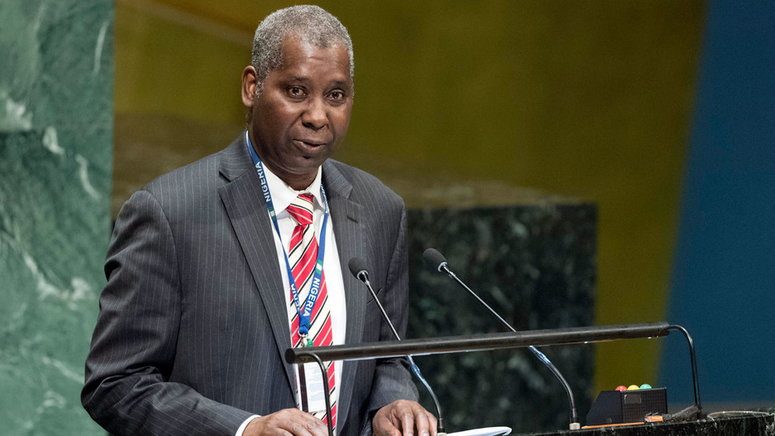
President of the United Nations General Assembly, Amb. Tijani Muhammad-Bande, on Wednesday called for inclusive agricultural policies to boost the fight against poverty and hunger.
He made the call during an interactive dialogue on “Targeting Hunger: South-South and Triangular Cooperation for Transforming Agriculture’’ at the UN Head headquarters in New York.
Muhammad-Bande, who is Nigeria’s Permanent Representative to the UN, said for agricultural policies to succeed, they must address the “historical and structural inequalities’’ undermining efforts to end hunger.
“Agricultural policies are development policies and they focus on mitigating hunger sustainably, creating jobs, generating incomes, and contributing to poverty eradication.
“These policies must pay due consideration to smallholder and family farmers, who produce almost 70 per cent of the world’s food.
“These 500 million food producers are often trapped in poverty, and even vulnerable to hunger and malnutrition,’’ he said.
The PGA, whose priorities include zero hunger and poverty eradication, said efforts must also be intensified to link smallholder farmers with buyers, technology suppliers and financial institutions.
According to him, progress on eradication of hunger or poverty is impossible if smallholders are left behind.
“It is our collective duty to ensure that everyone everywhere has access to adequate nutritious food. Food must be both accessible and affordable for all.
“This is particularly important for the 48 million children around the world, who are presently affected by stunting and wasting,’’ he said.
Muhammad-Bande also urged countries to focus on what he called the “female face of farming.”
He said women constituted almost half of the agricultural labour force in developing countries, but they get “only a fraction of the land, credit, agricultural training, information and inputs’’.
“Indeed, only 10 per cent of total aid for agriculture, forestry and fishing is directed towards women in agriculture.
“We must redouble our efforts and create policies and conditions that will not only alleviate the suffering of 820 million people who experience hunger today, but eliminate hunger in our world beyond 2030.
“The 2030 Agenda for Sustainable Development recognises that Sustainable Development Goal (SDG) 1: No Poverty, and SDG 2: Zero Hunger, must be addressed in unison,’’ he said.(NAN)
Zzzzzzzzzzzz
Keystone Bank partners NCF on tree planting campaign
In a bid to ensure sustainable cities and communities under the Sustainable Development Goal (SDG) 11 of the United Nations (UN), Keystone Bank Limited has partnered with the Nigerian Conservation Foundation (NCF) on a tree planting campaign in Lagos State. The trees are expected to absorb carbon dioxide in the environment and create an ecosystem that will help to reduce pollution.
Speaking on the campaign in Lagos recently, Mr. Adeyemi Odusanya, an Executive Director of the bank, said some staff members of Keystone Bank recently visited the NCF office in Lagos to plant some Mahogany trees.
He said the objective was to further the operations of the bank with the Sustainable Development Goals , adding that under the arrangement, NCF will nurture the plants to maturity.
The SDGs are a collection of 17 global goals designed to be a blueprint to achieve a better and more sustainable future for all. They were set in 2015 by the UN General Assembly and intended to be achieved by the year 2030.
The SDGs include: No Poverty, Zero Hunger, Good Health and Well-being, Quality Education, Gender Equality, Clean Water and Sanitation, Affordable and Clean Energy, Decent Work and Economic Growth, Industry, Innovation and Infrastructure.
Others are Reducing Inequality, Sustainable Cities and Communities, Responsible Consumption and Production, Climate Action, Life Below Water, Life On Land, Peace, Justice, and Strong Institutions and Partnerships for the Goals. The goals are broad based and interdependent.
Under the SDG 11 of Sustainable Cities and Communities, cities and human settlements are expected to be safe, resilient and sustainable. The target for 2030 is to ensure access to safe and affordable housing while the indicator that will be used to measure progress toward this target is the proportion of urban population living in slums or informal settlements.
Consequently, between 2000 and 2014, the proportion has fallen from 39 percent to 30 percent. Although the absolute number of people living in slums went from 792 million in 2000 to an estimated 880 million in 2014, movement from rural to urban areas has accelerated as the population has grown and better housing alternatives are now available.
However, in 2019, substantial progress was made in reducing the proportion of the global urban population living in slums, though more than one billion people continue to live in such situations.
Urgent action is, therefore, needed to reverse the situation which sees the vast majority of urban residents breathing poor quality air and having limited access to transport and open public spaces. So, there are profound repercussions for sustainability within the areas occupied by cities growing faster than their populations.
Keystone Bank is a technology and service-driven commercial bank offering convenient and reliable solutions to its customers.