
By Our Reporter
The 36 state governors of the federation have unanimously demanded the immediate withdrawal of the National Tax Reforms Bill, by President Tinubu.
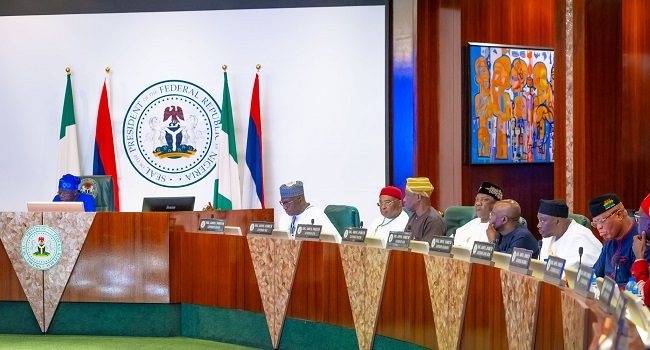
The governors, speaking during the National Economic Council, NEC, meeting on Thursday in Abuja, chaired by the Vice President Kashim Shettima, asked President Bola Tinubu to withdraw the Reforms Bill from the National Assembly to allow for wider consultations.
Disclosing the outcome of the meeting to journalists, Oyo State Governor, Seyi Makinde, said as part of resolutions reached at the council’s 144th meeting, council members agreed that there was need for wider consultations for better understanding of what the bill entails.
“Today (Thursday), NEC took a presentation from the Chairman of the Presidential Committee on Fiscal Policy and Tax Reforms. The primary focus is fair taxation, responsible borrowing and sustainable spending,” Makinde stated.
“After extensive deliberation, NEC noted the need for sufficient alignment between and amongst the stakeholders for the proposed reforms.
“So, Council, therefore, recommend the need to withdraw the bill currently before the National Assembly on tax reforms so that we can have wider consultations and also build consensus around these reforms for the benefit of the entire country, and also to give people…for them to know the vision and where we are moving the country in terms of tax reforms because there is a lot of miscommunication, misinformation.
“Council advised that the bill be withdrawn from the National Assembly, and then there will be consultations afterwards.”
The President Tinubu’s Tax Reform Bill plans at overhauling the taxation system in the country with the aim of achieving effective economic growth and increasing the tax-to-Gross Domestic Product ratio.
Taiwo Oyedele, led the Fiscal Policy and Tax Reforms Committee to the NEC meeting. The Committee was inaugurated in August 2023, with the mandate of restructuring the entire tax system in the country and instituting a unified revenue service for financial obligations for Nigerians.
The committee’s recommendations include integrating and harmonising the tax reforms into four executive bills. They are as as follows:
Firstly, the Nigeria Tax Bill, which aims at eliminating unintended multiple taxation and make Nigeria’s economy more competitive by simplifying tax obligations for businesses and individuals nationwide.
Secondly, the Nigeria Tax Administration Bill, which proposes new rules governing the administration of all taxes in the country, with the aim of unifying tax administrative processes across federal, state and local arms of government to facilitate ease of compliance across the country.
Thirdly, the Nigeria Revenue Service (Establishment) Bill seeks to rename the Federal Inland Revenue Service as the Nigeria Revenue Service to better reflect the mandate of the Service as the revenue agency for the entire federation, not just the Federal Government.
Fourthly, the Joint Revenue Board Establishment Bill proposes the creation of a Joint Revenue Board to replace the Joint Tax Board, covering federal and all states’ tax authorities.
The fourth bill also suggests establishing the Office of Tax Ombudsman under the Joint Revenue Board, serving as a complaint resolution body for taxpayers.
Recall that at a recent meeting of the 19 Northern Governors Forum, they had rejected the proposed tax reforms bill before the National Assembly which included a derivation-based model for Value -Added Tax. However, the Council called for a second look. Its decision came three days after the Northern Governors kicked against the reforms bill.
The Chairman of the forum, Governor Muhammed Yahaya of Gombe State, was reportedly said that the proposition negates the interest of the North and other sub-nationals, and would further exacerbate poverty and hardship in the region.
The Presidency, through the Special Adviser on Information and Strategy, Bayo Onanuga, has, however, countered that view, arguing that instead the tax reforms would benefit all states and harmonise the country’s tax laws for greater efficiency.
Onanuga, in a statement titled, ‘Explainer: Proposed tax reform bills not against the north; they will benefit all states’ on Thursday. he noted that the tax reform rather than increase the hardship on the people is designed towards improving and simplifying existing tax frameworks, noting that the current tax system lacked coordination across all tiers of government thus leading to confusion and inefficiency. He added that the new tax reform is aimed at correcting all these deficiencies for effective development.
“It’s instructive to note that these proposed laws will not increase the number of taxes currently in operation. Instead, they are designed to optimise and simplify existing tax frameworks.
“The tax rates or percentages will remain the same under these reforms, as they focus on ensuring a more equitable distribution of tax obligations without adding to the burden on Nigerians.
“The reforms will not lead to job losses. On the contrary, they are structured to stimulate new avenues for job creation by supporting a dynamic, growth-oriented economy. Importantly, these laws will not absorb or eliminate the duties of any existing department, agency, or ministry. Instead, they aim to harmonise revenue collection and administration across the federation to ensure efficiency and cooperation.”
“Without reform, this inefficiency will persist,” Onanuga said.
With Additional Reports From Punch