
The National Bureau Statistics, NBS, report reveals that inflation rate; the Consumer Price Index (CPI) which measures the rate of change in prices of goods and commodities increased to 21.91 per cent in February 2023, compared to 21.82 per cent in January.
The NBS, in its CPI report for February, which was released yesterday, attributed the 0.09 per cent increase in the headline index to an increase in the prices of food and other commodities during the review period.
Inflation rate for consumables every year has witnessed a substantial increment to 24.35 per cent in February, representing 7.24 per cent increase compared to 17.11 per cent in the corresponding month in 2022, owing to increase in the prices of oil and fat, bread, cereals and other food items.
According to the report, month-on-month, however, food inflation slowed to 1.90 per cent, which was 0.18 per cent lower compared to 2.08 per cent in January.
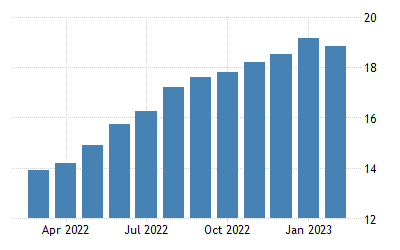
Conversely, core inflation was at 18.84 per cent year on year in February up by 4.83 per cent compared to 14.01 per cent recorded in February 2022, owing majorly to the price increases in gas, resulting in hike in transport fares; and subsequently affecting prices of vehicle spares among other things.
However, on a month-on-month basis, core inflation was 1.06 per cent, down by 0.76 per cent when compared to 1.82 per cent in January.
NBS also reports that year-on-year, urban inflation rose to 22.78 per cent or 6.53 per cent compared to 16.25 per cent in February 2022 while month-on-month, the index dropped to 1.85 per cent in February lower than 1.98 per cent in January.
In the same vein, rural inflation was at 21.10 per cent year-on-year which was 5.92 per cent higher than the 15.18 per cent in February 2022 while month on month, the rural stood at 1.58 per cent, down by 0.19 per cent compared to 1.77 per cent in January.
Also, states witnessed generally high inflation within the year in view. Among the states that experienced very high rate of inflation are: Edo (2.76 per cent), Ogun (2.64) and Yobe (2. 36 per cent). Others with highest inflation rates are: Bauchi (24.59 per cent), Rivers (24.40 per cent), and Ondo (24.27 per cent).
while Sokoto (18.90 per cent), Borno (18.94 per cent) and Cross River (19.62 per cent) recorded the slowest rise in the headline index.
Bayelsa (0.74 per cent), Borno (0.95 per cent) and Taraba (1.03 per cent) recorded the slowest rise on month-on-month inflation.
Kwara, Imo and Lagos states recorded food inflation of 29.51 per cent, 27. 47 per cent and 27.42 per cent respectively.