
Reactions have continued to trail the announcement by the United States Government to place a visa ban on Nigeria, just as President Trump extends an invitation to the Nigerian government to Washington DC to discuss matters bordering on good governance.
One of those who reacted to the ban was former Vice President of Nigeria and former Presidential candidate to the People’s Democratic Party, PDP, , Atiku Abubakar, who called on President Donald Trump not to punish Nigerians for the shortcomings and failure of the Muhammadu Buhari-led administration.
Atiku who claimed that Nigeria has been a major force for America’s development, said:
“I received with sadness the policy of the government of the United States of America to place Nigeria on its travel ban list,” Atiku said via a statement on Saturday.
“While I understand the reasons given by the Trump administration (the failure of the Muhammadu Buhari led administration to share information and to address issues of terrorism), the ban does not take into account the pro-American sentiments of the Nigerian public and the solidarity previous Nigerian administrations have had with the United States.
“I urge the government of President Donald Trump to consider the history of US-Nigerian relationships.”
He implored the Trump administration to also consider the pivotal role Nigeria, in partnership with the US, played in bringing peace to Liberia, an American sphere of influence, that now enjoys democracy because Nigerian blood and money paved the way for peace in that nation.
“Nigeria has also consistently voted in support of the United States and her allies at the UN and other multilateral world bodies. This is even as we are perhaps the biggest trading partner that the United States has in Africa, even where we had alternatives.”
He posited that the US stands to benefit if it allows open borders with a country like Nigeria that is able to provide skilled, hardworking and dedicated personnel in a two-way traffic, adding that
“The current Nigerian administration may have its deficiencies and deep faults, but the Nigeria people ought not to be punished for their inefficiencies.
The Former Vice President called on President Donald Trump to consider adopting measures that individually target those in government who have failed in their duties, rather than target the entire Nigerian population.”
Meanwhile, The United States Department of State has invited Geoffrey Onyeama, minister of foreign affairs and an interagency, delegation to Washington DC to discuss trade, security and good governance.
The invitation was made public less than 24 hours after the Donald Trump-led administration placed an immigrant visa ban on Nigeria.
According to the media note shared by the US Department of State, “on February 3-4, the Department of State has the pleasure of receiving Nigerian Foreign Minister Geoffrey Onyeama and his interagency delegation from the Federal Republic of Nigeria to Washington, D.C., for the 2020 U.S.-Nigeria Binational Commission”.
“The theme of this year’s BNC is ‘Innovation and Ingenuity,’ which reflects the entrepreneurial, inventive, and industrious spirit shared by the Nigerian and American people,” the note read.
“Established ten years ago, the Binational Commission is the premiere platform of engagement between Governments of the United States and Nigeria to expand cooperation and advance shared goals.
“Our delegations will discuss areas of strategic collaboration toward measurable progress, particularly in the areas of trade and investment, development, good governance, and security cooperation.”
Chad Wolf, acting secretary of the department of homeland security, had said the new immigration restrictions are designed to “address security concerns in the way the banned countries track their own citizens, share information with the U.S. and cooperate on immigration matters”.
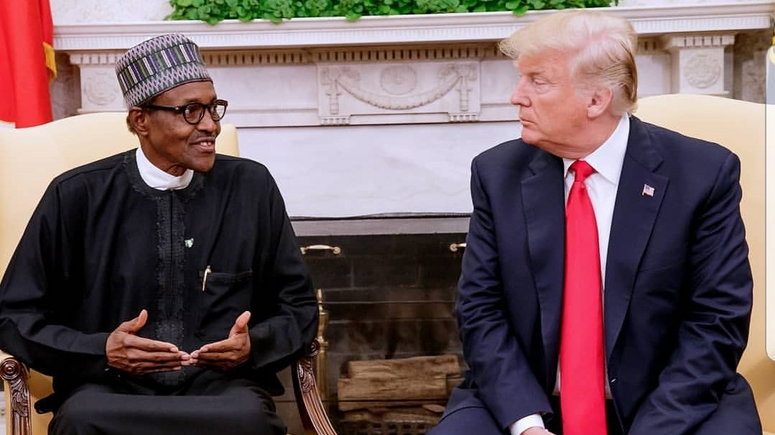
Before the visa ban, President Trump and President Muhammadu Buhari have met in the US to discuss issues surrounding the situation in Nigeria and agricultural trade between both countries.
Other countries affected by the visa ban are Eritrea, Sudan, Tanzania, Kyrgyzstan, and Myanmar.