
By Felix Olukayode
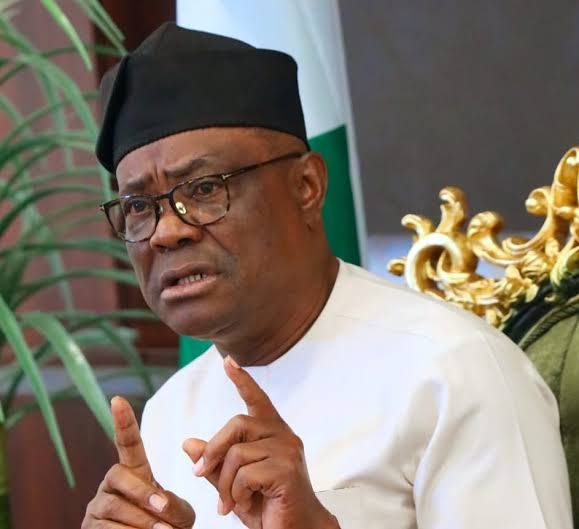
The Minister of the Federal Capital Territory (FCT), Nyesom Wike, is promoting a cross-party alliance known as the Rainbow Coalition to mobilize support for President Bola Tinubu’s re-election in 2027, bringing opposition politicians and governors into a political arrangement that has exposed tensions within the ruling All Progressives Congress (APC).
Wike, a member of the Peoples Democratic Party (PDP), said the initiative would unite APC members and Tinubu supporters across party lines without requiring them to abandon their political platforms. The coalition, which he helps coordinate in Rivers State and the FCT, is focused on securing the President’s second term rather than limiting support to APC members. “The major thing is Mr President. Whatever we are going to do, whoever has any idea or anything to contribute is to the success of Mr President. That is the whole thing,” he said during a media parley in Abuja.
“If you see that word, PBAT/APC, it means those who are supporting the President who are not members of the party, together with the party, are working together to achieve that purpose,” Wike said.
The alliance draws partly on the political realignments ahead of the 2023 presidential election, when Wike and other members of the PDP’s G5 group of governors opposed the party’s presidential candidate, Atiku Abubakar, amid a dispute over the party’s leadership and power-sharing arrangements. Their decision to withhold support from Atiku weakened the PDP’s internal cohesion and helped create the political conditions for Wike’s subsequent engagement with the Tinubu administration. The Rainbow Coalition extends that cross-party realignment, although its membership, structure, and operational arrangements remain subject to political negotiations.
The initiative has, however, triggered disagreements within the APC over who should control Tinubu’s campaign machinery and how political influence should be shared. APC governors, led by Imo State Governor Hope Uzodimma, have resisted arrangements they consider capable of undermining the party’s established structures. Wike has countered that politicians from other parties can support Tinubu while retaining their platforms and contesting governorship and legislative elections against APC candidates. The disagreement raises questions about how the coalition will coordinate its activities with the party’s official campaign organization.
The dispute has become particularly visible in Osun State, where Governor Ademola Adeleke, who won re-election on the Accord Party platform, has emerged as a prominent figure in the political realignment and was named a Tinubu campaign coordinator. The development has created friction with APC stakeholders, who insist that presidential campaign activities should be organized through the party’s recognized structure. The contest over campaign leadership highlights a central dilemma: accommodating influential figures from outside the APC could expand the President’s support base but also alienate party loyalists who expect to retain control of campaign operations and political appointments.
Political analysts believe that beyond the immediate disagreements, the coalition faces several potential pitfalls. Different parties and politicians may support Tinubu for different reasons, including their own electoral ambitions, making it difficult to agree on priorities and the distribution of political influence. Disputes over campaign leadership, candidate selection, and post-election appointments could deepen existing divisions, while APC members who feel sidelined may become less enthusiastic about mobilization. The absence of a clearly defined structure, shared program, and reliable mechanisms for resolving disputes could also undermine coordination. Moreover, endorsements by prominent politicians do not automatically translate into votes, particularly where their supporters have different loyalties or local political interests.
For the opposition, the alliance could complicate efforts to build a united challenge to Tinubu in 2027 by drawing influential figures away from their parties and widening existing divisions. But the coalition’s ultimate impact will depend on whether its leaders can reconcile competing interests, maintain cooperation with APC structures, and convert political agreements into grassroots support. Wike has dismissed resistance to the initiative, declaring: “For the Rainbow Coalition, it has come. It will stay. There’s nothing anybody can do about it.” Whether the alliance can withstand internal rivalries and deliver sustained electoral support remains an open question.
The structure is reportedly scheduled to be inaugurated by President Tinubu at the Banquet Hall of the Presidential Villa, Abuja, today, Wednesday, October 14, 2026, at 11:00 a.m.
The ceremony is expected to feature a whole lot of political bigwigs, not just from the ruling All Progressives Congress (APC) party, but from across the party lines.